
A yard that stays soggy after rain needs more than another layer of dirt. We look at where the water enters, where it collects and where it can go before choosing a fix. Across Charlotte NC, grading, roof runoff and construction compaction all affect how a yard dries.
Why red clay can stay wet in North Carolina
North Carolina's Piedmont region is dominated by rolling hills, with clay-rich subsoil common beneath the surface. Construction can bring that fine-textured material to the surface and compress it under heavy machinery. Compaction in Charlotte's red clay soil often leads to slower water movement, leaving roots with less air and the ground soft underfoot.
But clay soil is not automatically a drainage failure. Structure matters: connected pores allow water and air to move, while compaction closes those pathways. Color alone cannot tell you whether a particular area will drain well.
How clay drains also depends on the layers beneath it. Water may enter a loose surface layer and then slow at a compacted boundary. In some areas, disturbed fill differs from the original soil just a few steps away. That is why soil drainage needs to be checked where the problem occurs, not inferred from a nearby flower bed.
This distinction changes the work. Improving compacted ground in a planting area is different from intercepting water pouring off a roof. And a depression will keep collecting runoff even when the surrounding ground absorbs rain reasonably well. We start with the whole site rather than assuming every wet patch needs the same treatment.
Start with soil drainage and incoming water
Watch the next ordinary rain from a safe, dry spot. The first place that gets wet often explains more than the largest puddle afterward. Look for these clues before the water spreads:
- At the roof: overflowing gutters, a downspout ending beside the house or a buried outlet that no longer releases water.
- Across the surface: flow from a driveway, patio or higher section of the yard.
- In one low area: water gathers in the same depression while nearby areas dry.
- Between storms: ground remains wet despite little recent rain, suggesting irrigation, a leak or a persistent subsurface source needs checking.
Check existing grates and accessible discharge points for leaves and sediment. A blocked component may explain a recent change without requiring a new system. Note whether irrigation runs before the wet patch appears, especially if the problem continues during dry weather.
A routine fertility test guides plant nutrition, not the route a drain should follow. For yard drainage, the useful questions are about elevations, incoming flow, infiltration and a suitable outlet. Those checks help separate the source of the water from the place where you happen to notice it.
Four wet-yard patterns and what to check
Use these patterns to describe what you see. They help narrow the next inspection, rather than choosing equipment before the cause is understood.
Water beside a downspout
Check: where the roof discharge lands and whether its existing route is blocked.
Possible work: a dedicated conveyance route to an appropriate receiving area, with access for maintenance.
A puddle in the same depression
Check: the surrounding levels, the depth of the low spot and whether water has a surface exit.
Possible work: regrading or surface collection, depending on available fall and nearby structures.
Runoff crossing a path or patio
Check: the uphill source and how the finished surface redirects it.
Possible work: intercepting and conveying that flow before it reaches the walking area.
Soft ground that stays saturated
Check: compacted soil layers, irrigation and moisture below the surface.
Possible work: soil preparation, subsurface collection or a combination, after identifying a workable outlet.
Several patterns can occur together. A downspout might feed a low spot, while heavy foot traffic reduces absorption nearby. Fixing only the visible puddle leaves the incoming water unchanged.
What to ask clay soil specialists
Reshape surface flow
Grading changes where water travels over the ground. A shallow, properly shaped route can guide runoff around a usable area instead of through it. Raising one depression without checking the adjacent levels can simply move the problem to the next spot.
Our grading and leveling services address the relationship between usable surfaces, slopes and runoff. The finished yard still needs purposeful fall; “level” should not mean a perfectly flat surface with nowhere for rain to go.
Collect water where it arrives
Surface inlets can collect concentrated runoff, while a French drain can collect water entering a gravel-filled trench below or near the surface. These systems do different jobs. A buried perforated pipe is not automatically the best answer to a large stream coming off paving.
Before we install drainage, we check the collection point, route and receiving area together. A trench in saturated clay without a suitable discharge point can become another place to hold water. See our French drain installation service for the construction side of that decision.
The outlet needs attention too. Concentrating flow onto an eroding slope or toward a neighboring property can create a new problem. Existing public infrastructure, property boundaries and site constraints belong in the plan before excavation begins.
Prepare planting beds for healthy roots
In planting areas, adding organic matter can improve soil structure over time. Mature compost supports aggregation and pore space, which helps water drain better through the rooting zone while improving access to air. This is useful soil health work, but it does not remove a stream arriving from a roof or correct a reversed slope.
- Compacted lawn: core aeration may help near-surface compaction, but it cannot create an outlet for standing water.
- Planting beds: work suitable compost into the rooting area when conditions permit, rather than burying a restrictive layer beneath a thin cap.
- Wet garden areas: installing raised beds can improve the rooting environment, provided the surrounding runoff route is addressed too.
A few bags of sand do not reliably turn dense clay into free-draining garden soil. Imported topsoil also varies in quality. Choose materials for the intended use, and avoid working wet ground when equipment will smear or compact it further.
Keep the improvement specific to the planting space. Amending soil around new plants, protecting beds from repeated foot traffic and keeping heavy equipment off wet clay all address structure. Different soils need different preparation. None of those steps replaces correcting runoff that arrives faster than the ground can absorb it.
For seed selection and establishment after drainage work, use our separate guide to establishing a healthy lawn. New sod is a finishing step, not a remedy for an unresolved water source.
Plan lawn and landscaping upgrades together
The easiest time to coordinate water movement is before a patio, walkway or planting scheme fixes the finished levels. Otherwise, correcting a route later can mean lifting a surface you just paid to install.
- Set the destination first. Identify where runoff can be received without creating an erosion problem.
- Coordinate the levels. Check door thresholds, the foundation, existing paths and transitions into planted areas.
- Prepare for the intended load. Planting soil and a compacted crushed aggregate base serve different purposes. A material that supports roots is not automatically a suitable paving base.
- Keep maintenance possible. Avoid hiding collection points behind permanent features or making discharge areas inaccessible.
The landscaping Charlotte homeowners plan often combines patios, planting beds and open space. We coordinate patio planning with the surrounding levels so these finished spaces work together. Where a retaining wall changes the grade, its drainage details need their own consideration. Our retaining-wall drainage guide explains that separate part of the build.
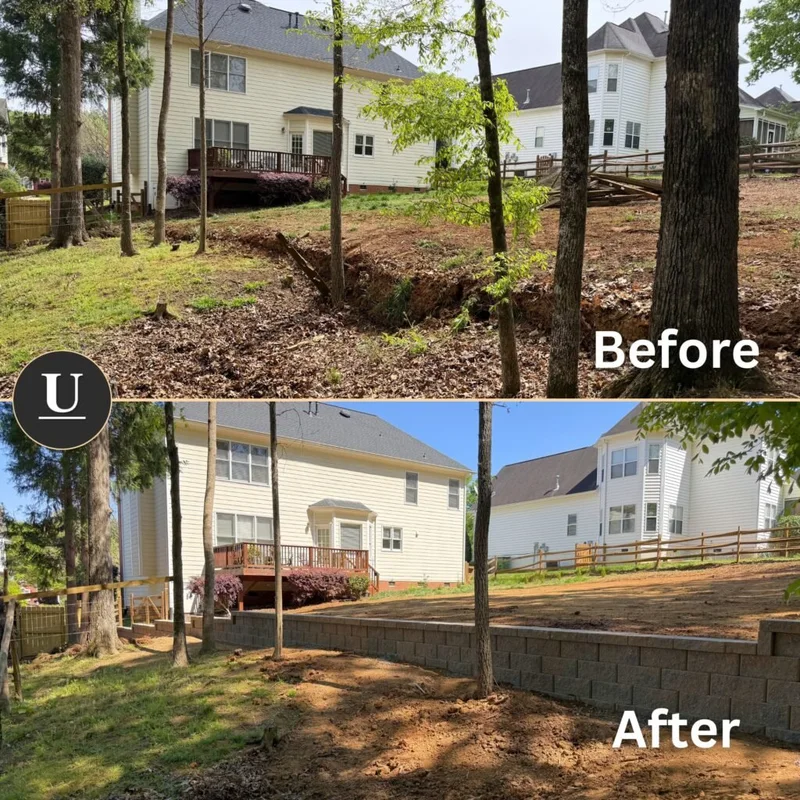
A Charlotte slope reshaped for a usable yard
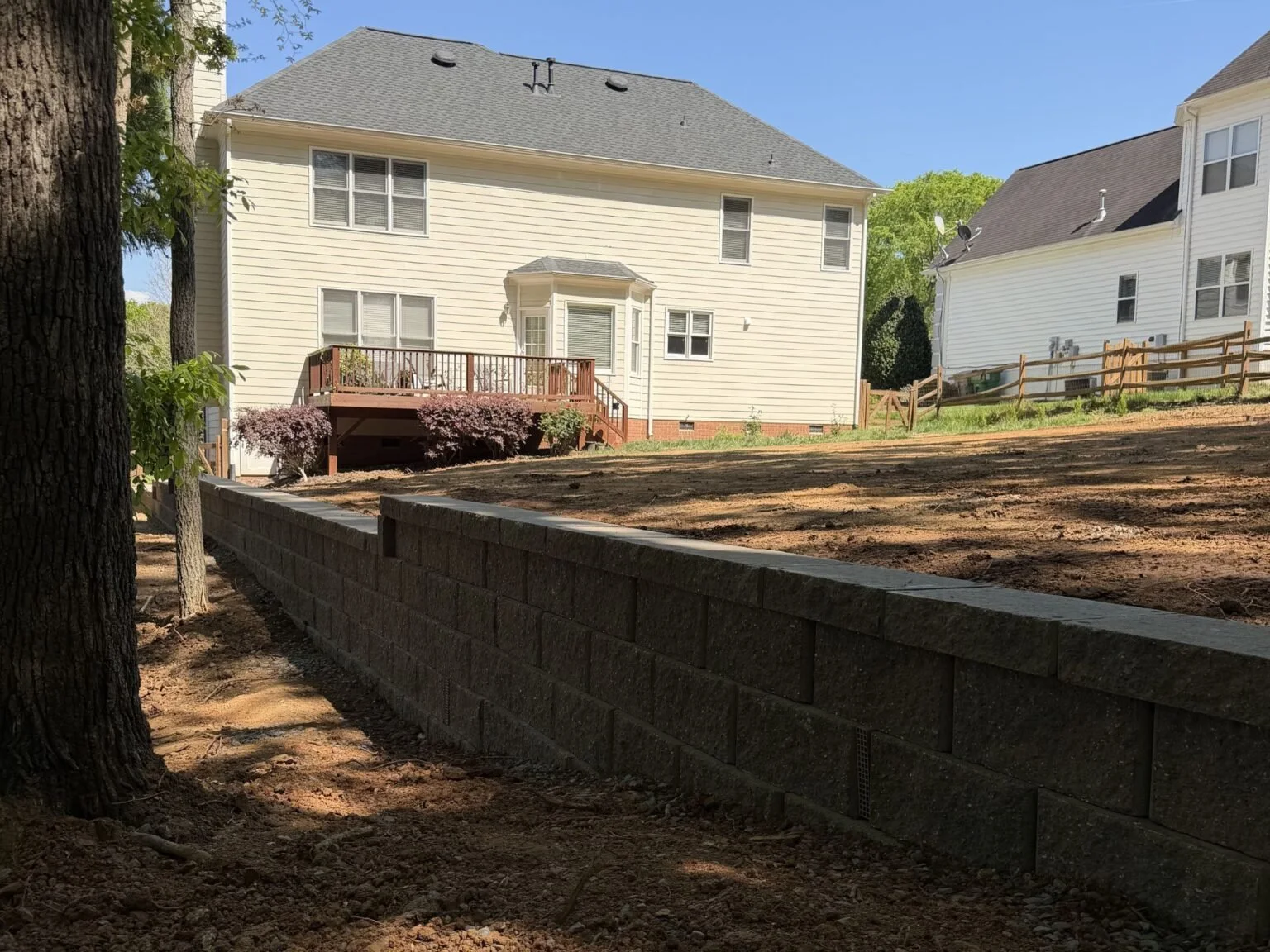
At Ridgeline Restoration in Charlotte, we combined a dark-charcoal segmental retaining wall with grading, leveling and erosion-control work on a steep backyard. The wall created a defined lower edge, while the reworked upper area was prepared for future landscaping.
The Ridgeline Restoration project shows why changes in elevation and the intended use of a yard need to be planned together. A cleaner surface is only part of the work; the relationship between the upper ground, wall and lower area shapes what can be built next.
Common questions about a soggy yard
Does every wet yard need a French drain?
No. Roof runoff may need a dedicated pipe, a surface depression may need grading, and blocked existing components may need clearing. The appropriate solutions follow the source and route of the water, not the name of the material in the yard.
Will adding topsoil solve the problem?
Not by itself. Covering slow-draining soil does not resolve poor drainage beneath the new layer. Topsoil may improve a rooting layer, but the underlying restriction or incoming flow remains. The amount, quality and placement need to fit the existing conditions rather than simply covering them.
Does the color tell me what needs fixing?
Finding brown clay soil in a wet patch does not tell you which drain to install. Even the most common soil type in a neighborhood can be compacted differently from one lot to the next. We check the layers and water movement, not just the color.
Why does one patch stay wet after the rest dries?
When Charlotte clay does not perk well, water can collect above a compacted layer. We check how far that layer extends, where runoff enters and whether the area has an outlet. That tells us whether to loosen the rooting area, reshape the surface or collect and carry the water away.
What should I send when asking for help?
Send after-rain photos, a wider view showing nearby paving and downspouts, and a note about how long the area stays wet. Tell us what you want to use the space for. If you already have a proposed system, include its sketch or brochure so we can compare the collection route and outlet with the site. We can then assess the next step and prepare a quote for the appropriate work.